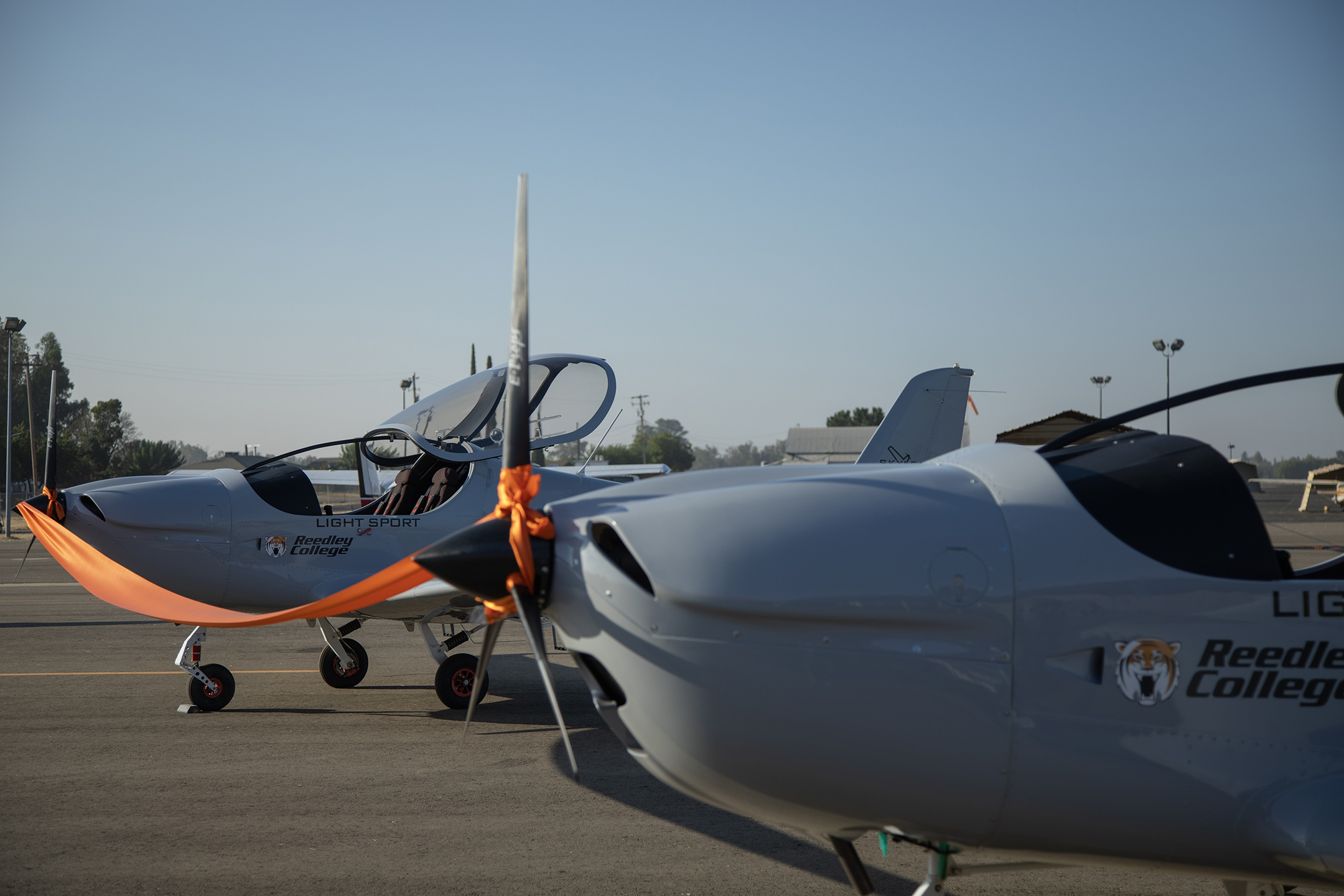

REEDLEY – Following a recent move by the Reedley City Council, the wheels are now up on a new era for local aviation.
On Aug. 25, the Reedley City Council unanimously approved a transfer of ownership of four electric training aircraft to Reedley College for use in the school’s aviation program. Once fully covered under Reedley College’s flight school insurance policies, the additional crafts will greatly increase air time for students aiming to log their required 1,500 hours.
According to Reedley College President Jerry Buckley, the school owned five light-sport trainer aircraft before this recent transfer.
“The limiting factor in a flight school is always the number of aircraft available for students to actually use,” said Buckley in an interview. “When you basically double the number of aircraft, you’re theoretically doubling the amount of flight time for students.”
When presenting the item to the council, City Manager Nicole Zieba said the city originally acquired the aircraft through a 2017 partnership with the city of Mendota, and nonprofit organizations New Vision Aviation and CALSTART. With a grant of just over $1 million, the group acquired four all-electric aircraft from the country of Slovenia.
Zieba noted the significance of this partnership, saying that before the council took its vote to transfer ownership of the planes, the city of Reedley had the largest concentration of production all-electric aircraft not just in the nation, but also the northern hemisphere.
Zieba called the handing off of these planes “bittersweet” and took a moment to honor the late Robert Beck, former city council member who pushed for Zieba to bring electric aircraft to Reedley Municipal Airport.
“It was Mr. Beck who said ‘Nicole, I want you to go after a million dollars for some electric planes,’ and I thought he was nuts,” Zieba said to the council. “That taught me back then to support other people’s vision even if I couldn’t see it, and boy, he had vision and it went places.”
During council comments, Mary Fast sought to confirm that the planes will be used by students for flight training, saying that was the stated intent of the partnership’s original documentation. Zieba said they will indeed be used in student flights, but noted that one of the four planes requires so much maintenance that it may not be deemed air-worthy and could instead be used for parts.
Buckley later explained in an interview that since the incoming planes are a “first-generation product,” they don’t have the same flight range as newer models, and thus will be used for touch-and-go flights where students can practice takeoffs and landings.
After reflecting on the planes’ historical significance to the city of Reedley, and hearing about the benefits they will bring to future generations of aspiring pilots, the council voted 4-0 to approve the transfer, with Councilmember Christopher Arriaga being absent.
Buckley said that with ownership of the planes now transferred, the next major step will be to insure the planes under two separate policies, one for when they’re on land and another for the air. He noted that the school did not account for these additional planes during its last budget development cycle, but said he anticipates a request for a budget modification within the next month.
Looking to the future of Reedley College’s aviation program, Buckley expressed excitement over the school being on track to become to Part 141 flight school, which the Federal Aviation Administration describes as being “able to provide a greater variety of training aids and require dedicated training facilities, flight instructor oversight and FAA-approved course curricula.”
According to Buckley, this is a qualification that the school could reach within the next two years.
As enrollment in Reedley College’s flight school becomes more popular over time, with a current total of 38 first and second year students, Buckley anticipates a lot of upcoming opportunities for young pilots as older generations retire.
“We’re seeing anywhere from tens of thousands to hundreds of thousands of job openings projected over the next 20-30 years as these retirements continue, so if we want to keep our air transportation system running, we have to have additional people trained and ready to go,” Buckley said.