
CENTRAL VALLEY – There may be a big, beautiful surprise for Valley agriculture beneath the surface of the giant budget bill passed by Congress earlier this month.
Tucked away in the “One, Big Beautiful Bill,” the tax cut and spending law summarizing President Donald Trump’s second-term agenda, is a billion dollars in grant money for water infrastructure managed by the U.S. Bureau of Reclamation, Geoff Vanden Heuvel, Director of Regulatory and Economic Affairs for the Milk Producers Council, wrote in a July 11 post.
Vanden Heuval noted the money is designated to pay for “construction and associated activities that restore or increase the capacity or use of existing conveyance facilities constructed by the Bureau of Reclamation or for construction and associated activities that increase the capacity of existing Bureau of Reclamation surface water storage facilities.” He goes on to state, “None of the funds provided under this section shall be reimbursable or subject to matching or cost-sharing requirements.”
He credited California Congressmen David Valadao of Hanford, California and Vince Fong of Bakersfield, California for being “instrumental in getting this money into the bill.” He touted the funding as a “very significant federal investment in western water infrastructure.”
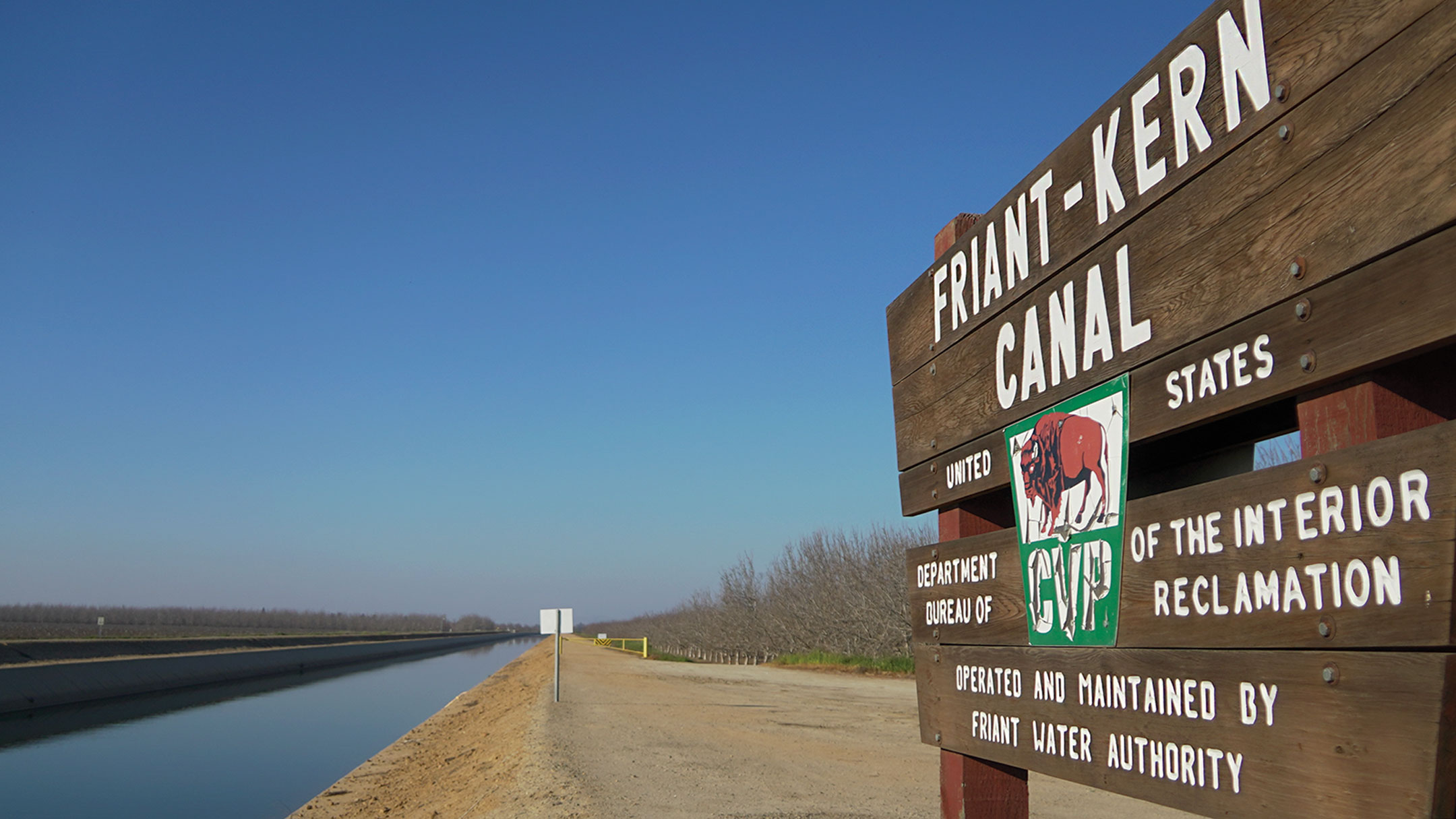
The money could be used to help restore capacity of Valley canals, like the Friant-Kern Canal, facing reduced capacity from land subsidence that’s coupled without local cost sharing obligations. The Middle Reach Capacity Correction Project currently underway is a joint effort between the canal’s operator, Friant Water Authority, and the Bureau of Reclamation, to repair a 33-mile stretch of the 152-mile canal south of Lindsay to McFarland.
The gravity-fed canal has lost 60% of its design capacity due to land subsidence, caused by over drafting groundwater during ongoing drought conditions from 2011-2019.
Phase 1 of the project was completed in June 2024 and repaired 10 miles of the canal by building a new concrete-lined section running parallel to the sunken stretch of the original canal between Avenue 136 and Avenue 64 in Tulare County. No timeline has been set for the next phases, which will repair portions of the canal north of Avenue 136 to 5th Avenue near Strathmore and south of Avenue 64 to Lake Woollomes near McFarland.
The estimated cost of the project is $500 million in total, with $325 million of work to go in the remainder of the affected 33-mile section.
The federal funding, coupled with a new law proposed by State Senator Anna Caballero (D-Merced), could signal a paradigm shift in thinking about California water resources. Caballero’s Senate Bill 72 calls for California to draft a plan with “an interim planning target of 9,000,000 acre-feet of additional water, water conservation, or water storage capacity to be achieved by 2040.” The bill recently passed through the California Senate and its first Assembly committee without a negative vote.
“The pendulum seems to be shifting,” Vanden Heuval wrote. “Stay hopeful, my friends.”
Releasing the money for projects is still months away, Vanden Heuval noted that the Bureau of Reclamation will still need to draft rules for the funding and that won’t happen until a new commissioner can be appointed to run the organization. Ted Cooke, former general manager of one of Arizona’s largest water agencies, is awaiting Senate confirmation which could take several more months.
“We definitely have a lot of problems and challenges in California. But self-government gives us the capacity for correction,” Vanden Heuval wrote.
Mexico slapped with tomato tariff
The U.S. pulled out of a 30-year trade agreement with Mexico this week, adding a 17 to 21% tariff on most Mexican tomatoes coming into the country. The move is expected to raise consumer prices for the popular vegetable, with 70% of all tomatoes consumed in the U.S. coming from Mexico.
“The (Tomato Suspension Agreement) has failed to protect U.S. tomato growers from unfairly priced Mexican imports, as Commerce has been flooded with comments from them urging its termination. This action will allow U.S. tomato growers to compete fairly in the marketplace,” the U.S. Department of Commerce announced April 14 in a preview of the withdrawal.
The U.S. imported $3.12 billion worth of fresh tomatoes from Mexico last year. The new announcement is separate from Mr. Trump’s trade war escalation promising a new 30% tariff on the European Union and Mexico that will take effect on Aug. 1, 2025. Concern in the Valley ag community looks to avoid a trade war with Mexico, a country with “key destinations for U.S. dairy exports, casting further doubt over U.S. dairy trade prospects in the coming months,” according to the Milk Producers Council.
The tomato tariff is being hailed by Florida growers but not by farmers in Texas and Arizona, who worry that consumers will see higher prices.
“We don’t want tomatoes to become the new egg crisis,” Rep. Vicente Gonzalez, D-Texas, said during a July 11 news conference, according to the Rio Grande Guardian.
Gonzalez, along with other Texas lawmakers and the Texas International Produce Association (TIPA), are requesting a 90-day delay to withdraw from the agreement to allow more consideration and resolutions for the issue. Dante Galeazzi, CEO of TIPA, said the Tomato Suspension Agreement is crucial to South Texas.
“Terminating this agreement will undo three decades of stability and bring about a 17% duty on all Mexican tomatoes entering this country,” Galeazzi said during the same Friday news conference as Gonzalez.
The Packer, a major produce trade publication, reports that U.S. consumers could see increased tomato prices due to potential shifts in the U.S.-Mexico tomato trade, specifically the termination of the 2019 tomato suspension agreement. While field-grown tomatoes cost approximately $1.70 per pound in May 2025, the termination of this agreement could lead to a 10% price increase and a 5% decrease in demand, according to a professor of agribusiness at Arizona State University.
NatureSweet, a major greenhouse tomato grower based in Mexico chimed in. The company told FOX Business the suspension agreement has stabilized prices for nearly 30 years and its removal could lead to volatile supply and price spikes.
“As a Texas-based U.S. company in a low-margin business, we will really have no choice but to raise prices by close to 10% in order to be able to continue bringing our healthy vine-ripe specialty tomatoes to our consumers,” Skip Hulett, chief legal officer for NatureSweet, told FOX Business last week.
June farm equipment sales are down
Associated Equipment Manufacturers (AEM) reports U.S. sales of agricultural tractors and combines didn’t see any increases in June 2025. Total agricultural tractor sales fell 4.4%, while combine sales dipped 43.7% compared to June 2024.
“The ongoing slump in U.S. combine and tractor sales demonstrates the market challenges facing the agricultural sector,” said AEM Senior Vice President Curt Blades. “We know farmers are hesitant to make major investments with global trade instability, high interest rates, and increased input prices.”
Growing oranges is expensive
California Citrus Mutual (CCM) says it costs $4,215 per acre to grow navel oranges in California in 2025. That’s up from $3,300 in 2020 (a 35% increase), $2,712 in 2015 (a 75% increase), $2,099 in 2010 (a 125% increase) and $1,555 in 2005 (a 171% increase).
Additionally, CCM reported that picking and hauling costs for navels are $1,210 per acre in 2025. Those costs are up 45% for five years, 60% for 10 years, 90% for 15 years and 110% for 20 years.
Eggs protect against Alzheimer’s
Older adults who eat eggs more than once a week may be less likely to develop Alzheimer’s dementia, according to a new study published in The Journal of Nutrition. The researchers found that participants who ate eggs weekly had a lower rate of clinical diagnosis and fewer Alzheimer’s-related brain changes after death. The study also identified dietary choline, a key nutrient found in eggs, as one possible contributor to this protective effect.